
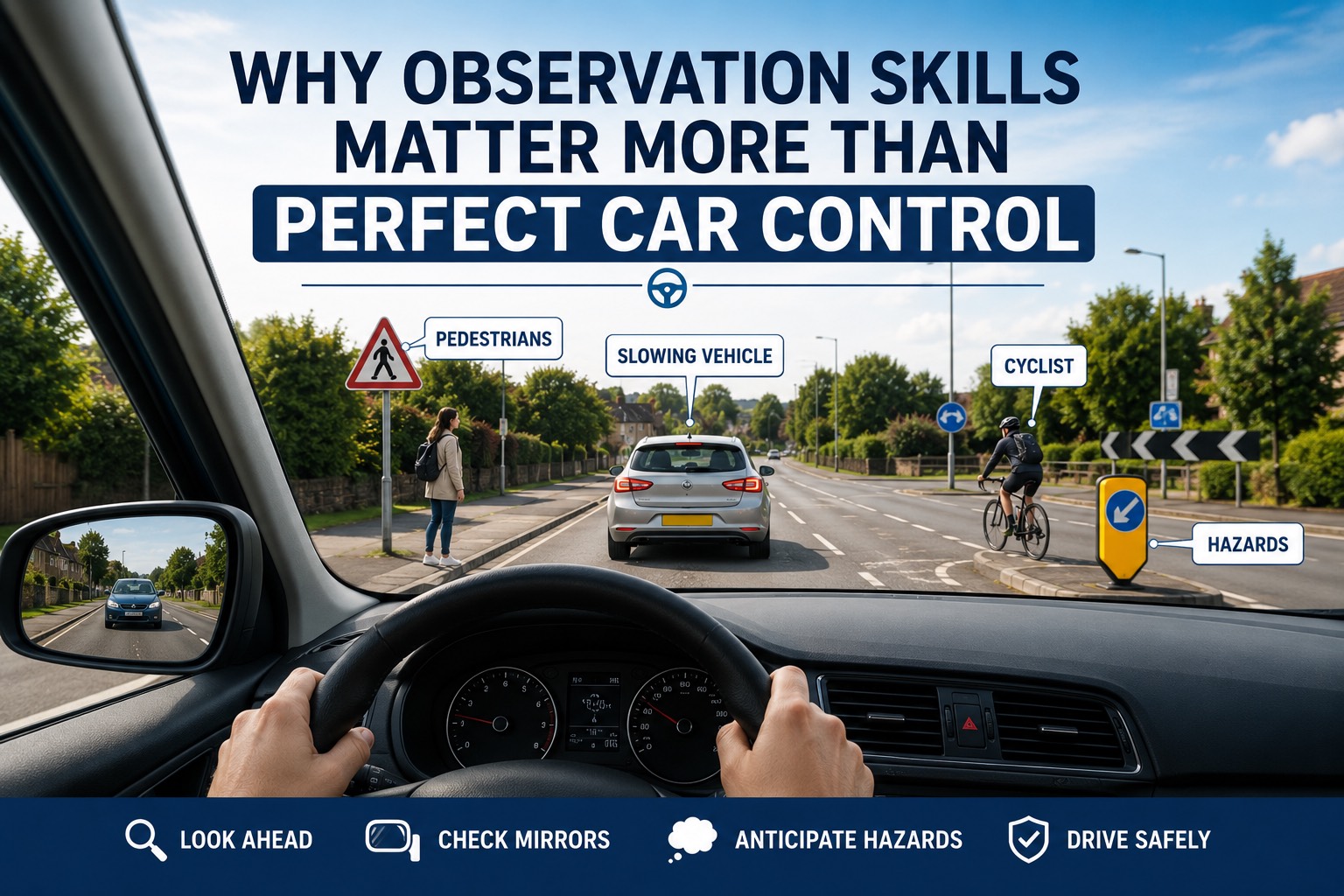
Learn why observation skills are more important than perfect car control. Discover how STUART’S Driving School helps learner drivers become safer, more confident, and test-ready across Central Scotland.
Why Observation Skills Matter More Than Perfect Car Control
Learning to drive involves much more than steering accurately or changing gears smoothly. While good vehicle control is essential, the ability to observe your surroundings, anticipate hazards, and make safe decisions is what truly makes someone a confident driver.
Every journey presents different challenges, from busy roundabouts and rural roads to pedestrians, cyclists, changing weather, and unexpected hazards. Developing strong observation skills helps learner drivers stay aware of these situations and respond safely without feeling overwhelmed.
At STUART’S Driving School, our DVSA-approved instructors introduce observation techniques from the very first lesson. Through structured driving lessons across Edinburgh, Livingston, Falkirk, Stirling, Fife, West Lothian, and throughout Central Scotland, learners build the awareness and judgement needed for a lifetime of safe driving—not simply to pass the practical driving test.
What Are Observation Skills?
Observation is one of the most important skills every driver develops. It involves continuously scanning the road ahead, checking mirrors regularly, recognising potential hazards early, and planning your next action before a situation becomes dangerous.
Good observation means paying attention to:
- Mirrors
- Road signs
- Road markings
- Pedestrians
- Cyclists
- Junctions
- Roundabouts
- Traffic lights
- Weather conditions
- Other road users
Rather than reacting at the last moment, good observation allows drivers to remain calm, make informed decisions, and maintain better control of every situation.
Why Observation Matters More Than Car Control
Vehicle control naturally improves with practice. Most learner drivers become comfortable using the clutch, steering smoothly, and changing gears after several lessons.
Observation, however, is a lifelong skill that influences every driving decision you make.
For example, a learner may perform a perfect hill start but fail to notice a cyclist approaching from behind. Similarly, someone may reverse perfectly into a parking bay but forget to check their blind spot before moving away.
Without effective observation, even excellent vehicle control cannot prevent avoidable mistakes. This is why DVSA examiners place significant importance on observation throughout the practical driving test.
Observation Is a Habit, Not a One-Time Check
Many learner drivers believe observation only matters before turning, changing lanes, or pulling away. In reality, safe drivers observe continuously throughout every journey.
Good drivers regularly:
- Scan well ahead
- Check mirrors frequently
- Read road signs early
- Monitor traffic behind and beside them
- Watch for developing hazards
- Adjust speed before situations become risky
Making observation a daily habit reduces stress, improves planning, and creates smoother, safer journeys.
The Mirror Signal Manoeuvre (MSM) Routine
One of the first techniques learner drivers develop is the Mirror–Signal–Manoeuvre (MSM) routine. Following this consistently helps drivers make safe decisions in every driving situation.
The MSM routine helps you:
- Check surrounding traffic before acting
- Communicate clearly with other road users
- Complete manoeuvres safely
- Reduce the risk of collisions
- Build confidence in busy traffic
With regular practice, the MSM routine becomes second nature and supports safe, responsible driving throughout your driving career.
Observation Helps You Recognise Hazards Earlier
Driving safely is about recognising potential problems before they become dangerous.
Strong observation skills help you identify:
- Pedestrians waiting to cross
- Cyclists approaching from behind
- Vehicles emerging from side roads
- Drivers braking suddenly
- Children playing near the road
- Temporary roadworks
- Changes in speed limits
Early hazard recognition gives you valuable time to slow down, adjust your road position, or stop safely when necessary.
A Practical Example
Imagine you’re approaching a pedestrian crossing.
A learner focused only on steering may continue at the same speed until someone steps onto the crossing.
A learner with strong observation skills notices people waiting nearby, checks the mirrors, eases off the accelerator, and prepares to stop if required.
This type of forward planning is exactly what DVSA examiners expect during the practical driving test because it demonstrates awareness, anticipation, and sound judgement.
Common Observation Mistakes Learner Drivers Make
Most learner drivers experience similar challenges while developing observation skills.
Common mistakes include:
- Forgetting mirror checks before slowing down
- Missing blind spot checks before moving off
- Looking only at the vehicle directly ahead
- Rushing through junctions
- Failing to anticipate other road users’ actions
- Reacting too late to changing road conditions
These habits improve through structured lessons, regular practice, and professional coaching.
How STUART’S Driving School Develops Better Observation Skills
Observation develops through consistent coaching and real driving experience.
Our experienced DVSA-approved instructors encourage learners to:
- Scan further ahead
- Check mirrors regularly
- Identify hazards early
- Read road signs sooner
- Plan ahead for junctions and roundabouts
- Maintain safe following distances
- Make calm, informed driving decisions
This coaching approach helps learners become independent drivers rather than relying on constant instruction.
Observation During the Practical Driving Test
Throughout the practical driving test, the examiner continually assesses how effectively you observe your surroundings.
You will be expected to:
- Use mirrors correctly and at the appropriate times
- Check blind spots before moving off
- Approach junctions with effective observation
- Respond safely to pedestrians and cyclists
- Adapt to changing traffic conditions
- Show continuous awareness of other road users
Good observation demonstrates that you can drive safely and responsibly without supervision.
Real-World Experience Strengthens Observation Skills
Observation improves every time you experience different road layouts and driving environments.
During lessons with STUART’S Driving School, learners gain experience on:
- Edinburgh city streets
- Residential roads
- Rural country roads
- Busy town centres
- Dual carriageways
- Spiral roundabouts
- Higher-speed roads
Practising in a variety of environments helps learners adapt confidently to different road conditions and traffic situations.
Why Observation Creates Safer Drivers for Life
Passing the practical driving test is only the beginning of your driving journey.
The skills that keep you safe for years to come are your ability to observe, anticipate hazards, and make informed decisions.
Strong observation habits help you:
- Stay alert in unfamiliar areas
- Respond calmly to changing road conditions
- Protect yourself and other road users
- Reduce the risk of collisions
- Drive confidently in different weather conditions
- Continue improving as an experienced driver
These are lifelong skills that remain valuable long after you receive your driving licence.
Start Learning with STUART’S Driving School
At STUART’S Driving School, we believe that safe driving begins with strong observation skills. Our experienced DVSA-approved instructors provide structured driving lessons that help learners develop awareness, sound judgement, and confidence from their very first lesson.
Whether you’re learning to drive for the first time or preparing for your practical driving test, we’ll help you become a safe, responsible, and independent driver across Edinburgh, Livingston, Falkirk, Stirling, Fife, West Lothian, and throughout Central Scotland.