
Learn why good road positioning is essential for safe driving. Discover how STUART’S Driving School helps learner drivers improve confidence, control, and decision-making across Central Scotland.
Why Good Road Positioning Is Essential for Safe Driving
Learning to drive involves much more than steering smoothly or changing gears correctly. One of the most important skills every learner driver develops is understanding how to position the vehicle safely on the road.
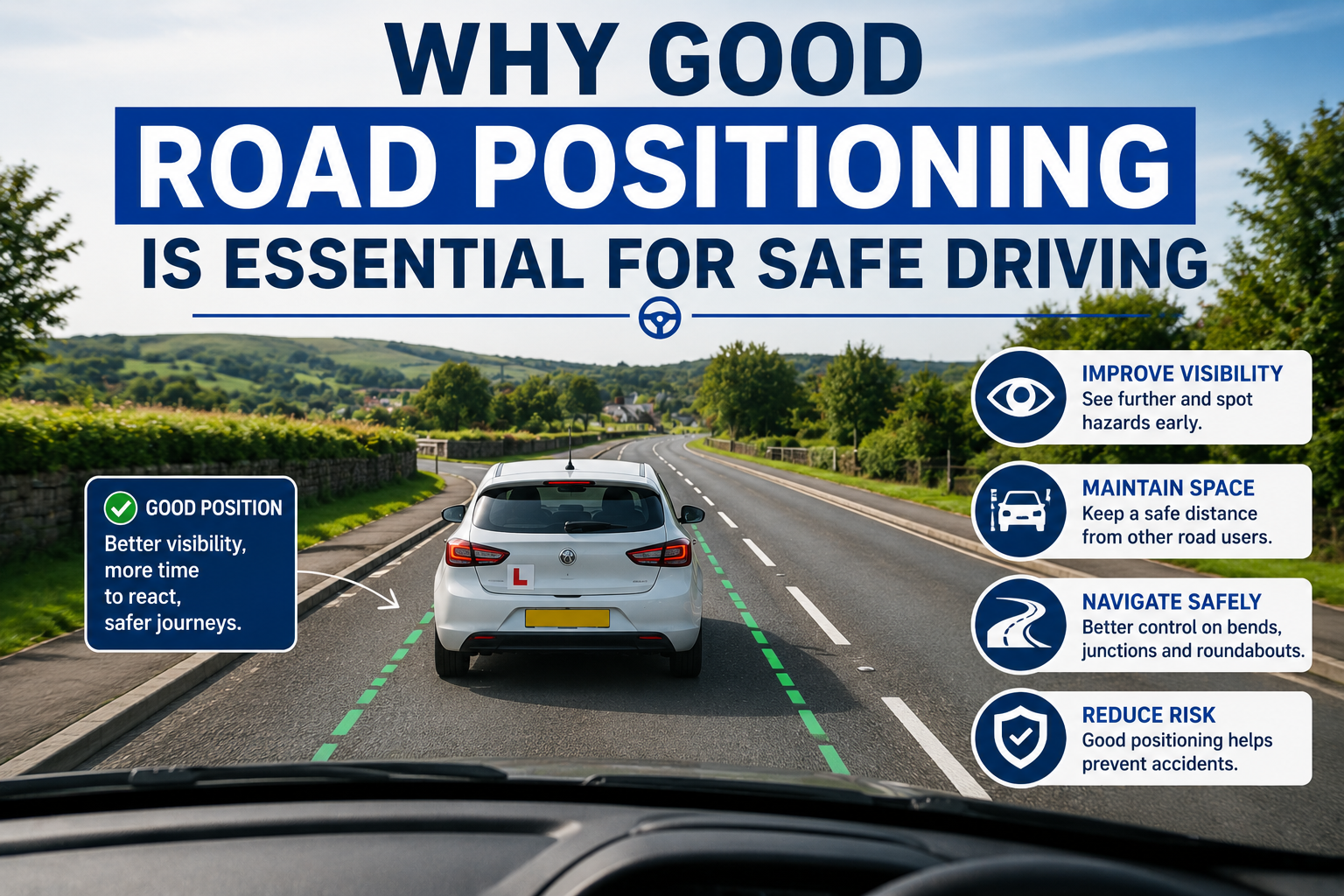
Good road positioning improves visibility, creates space between you and other road users, and gives you more time to react to changing traffic conditions. It also demonstrates confidence, awareness, and sound decision-making—qualities that the Driver and Vehicle Standards Agency (DVSA) expects every learner to develop before driving independently.
At STUART’S Driving School, our DVSA-approved instructors teach correct road positioning from the very first lesson. Through structured driving lessons across Edinburgh, Livingston, Falkirk, Stirling, Fife, West Lothian, and throughout Central Scotland, learners develop safe driving habits that prepare them for both the practical driving test and everyday driving.
What Is Road Positioning?
Road positioning is the way you place your vehicle within your lane and how you adjust that position depending on the road layout, traffic conditions, and potential hazards around you.
Maintaining the correct position allows you to:
- Improve visibility ahead.
- Create safe space around your vehicle.
- Give other road users clear intentions.
- Reduce the risk of collisions.
- Navigate bends, junctions, and roundabouts safely.
Good positioning is not about driving in exactly the same place all the time. It means making sensible adjustments based on the situation while remaining safe, legal, and predictable.
Why Road Positioning Is So Important
Many learner drivers focus on steering accurately and changing gears smoothly. While these are essential skills, correct road positioning influences almost every driving decision you make.
Positioning your vehicle correctly helps you:
- See developing hazards earlier.
- Maintain safe distances from other vehicles.
- Improve visibility at junctions.
- Navigate bends safely.
- Avoid unnecessary risks.
- Drive more confidently in busy traffic.
By consistently choosing the safest position on the road, you give yourself more time to observe, plan, and respond to changing situations.
How Road Positioning Changes in Different Situations
Approaching Junctions
Good positioning improves your view of approaching traffic and helps other drivers understand your intentions. Slowing down early and selecting the correct lane makes junctions safer and smoother.
Driving Around Bends
Maintaining an appropriate road position helps improve visibility around bends while giving you enough space to react safely if another vehicle appears unexpectedly.
Meeting Oncoming Traffic
On narrow roads, good positioning allows both vehicles to pass safely while maintaining enough clearance from parked cars, kerbs, or road edges.
Roundabouts
Correct lane discipline and positioning are essential when entering, travelling around, and exiting roundabouts. Choosing the correct lane early helps reduce confusion and improves safety.
Dual Carriageways
Maintaining a consistent lane position while keeping a safe following distance helps traffic flow smoothly and safely at higher speeds.
Common Road Positioning Mistakes Learner Drivers Make
Many learners experience similar positioning errors while gaining experience.
- Driving too close to the kerb.
- Positioning too close to the centre line.
- Selecting the wrong lane at roundabouts.
- Cutting corners when turning.
- Turning too wide at junctions.
- Leaving insufficient space around parked vehicles.
- Failing to adjust position for changing road conditions.
These mistakes are common during the learning process and improve through regular practice with professional instruction.
Road Positioning and the Practical Driving Test
During your practical driving test, the examiner continually assesses how safely you position the vehicle.
They will expect you to:
- Maintain the correct lane position.
- Position safely before turning.
- Approach junctions correctly.
- Use appropriate road positioning on bends.
- Keep safe clearance from parked vehicles.
- Adapt your position to traffic and road conditions.
Consistent road positioning demonstrates confidence, awareness, and good judgement throughout the test.
How STUART’S Driving School Teaches Safe Road Positioning
At STUART’S Driving School, learners develop road positioning skills through structured lessons and real-world driving experience.
Our instructors help learners:
- Read the road ahead.
- Choose the safest lane position.
- Improve observation techniques.
- Maintain safe following distances.
- Navigate complex junctions and roundabouts.
- Adapt confidently to changing traffic conditions.
Lessons are tailored to each learner’s progress, helping build confidence gradually while encouraging safe, independent driving.
Building Safe Driving Habits for Life
Road positioning is not only important for passing the practical driving test. It is a lifelong driving skill that helps reduce risk, improve awareness, and increase confidence every time you drive.
Developing good positioning habits allows you to make smoother decisions, protect other road users, and remain calm in a variety of driving situations.
Start Learning with STUART’S Driving School
At STUART’S Driving School, we believe that safe driving begins with strong foundations. Our experienced DVSA-approved instructors provide structured lessons that help learners develop effective road positioning, observation, decision-making, and confidence from the very first lesson.
Whether you’re learning to drive for the first time or preparing for your practical driving test, we’ll help you become a safe, responsible, and independent driver across Edinburgh, Livingston, Falkirk, Stirling, Fife, West Lothian, and throughout Central Scotland.