
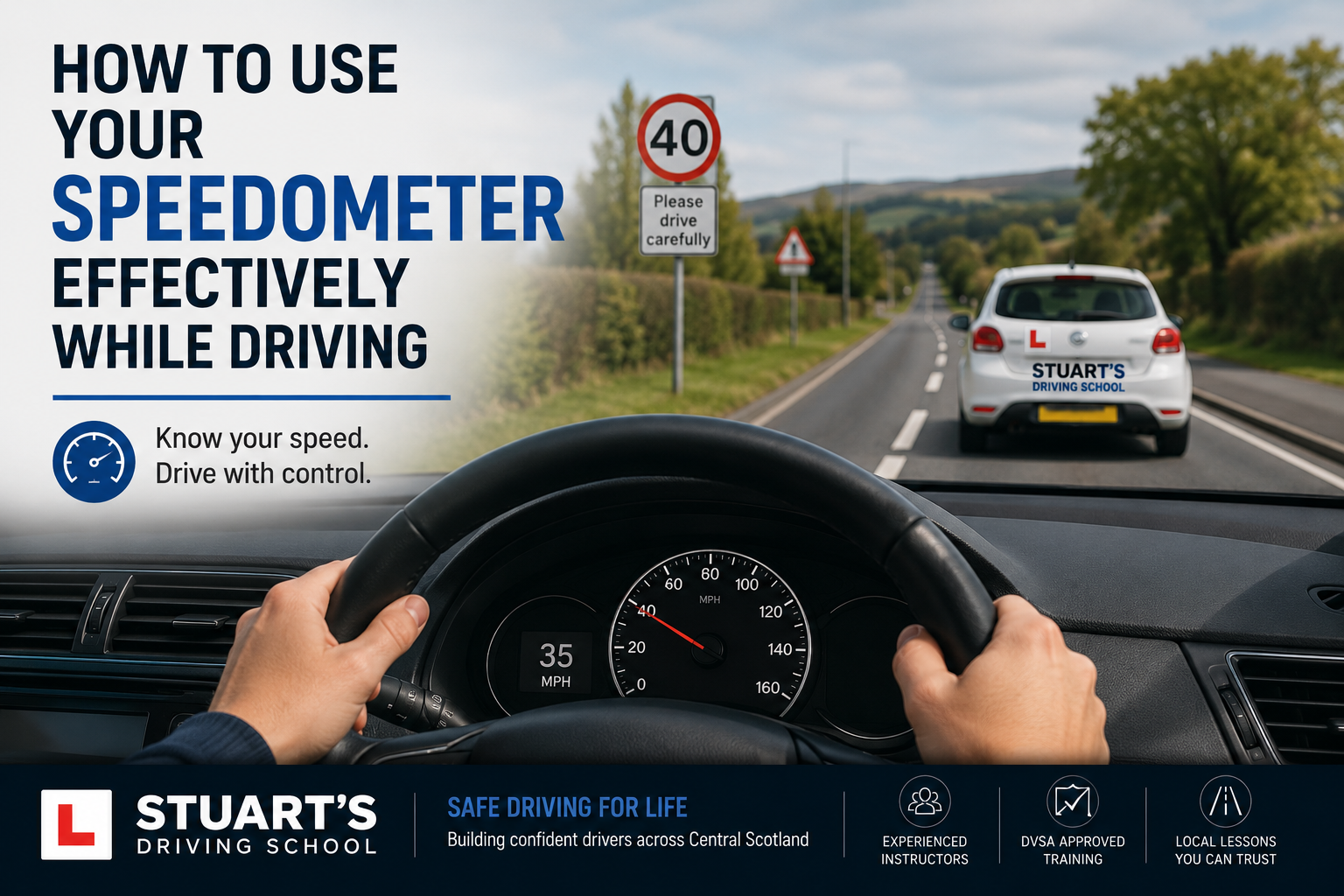
How to Use Your Speedometer Effectively | STUART’S Driving School
Learn how to use your speedometer effectively, understand speed limits, and adjust your speed safely with practical driving lessons from STUART’S across Central Scotland.
Why Speed Awareness Matters When You Drive
Learning to drive involves much more than knowing how to operate a vehicle. A safe driver needs to understand what is happening around them, recognise the appropriate speed for the situation, and remain in control when road conditions change.
Your speedometer is an important tool that helps you monitor how fast you are travelling. However, effective speed awareness is not simply about watching the number on the dashboard. It is about checking your speed regularly, understanding the speed limit, and recognising when conditions require you to slow down.
At STUART’S Driving School, we help learners develop the control, awareness and judgement needed for safe driving. Our lessons are designed to build practical skills that prepare learners for both the practical driving test and everyday journeys across Central Scotland.
What Does Good Speed Awareness Mean?
Good speed awareness means knowing how fast you are travelling without becoming distracted by the speedometer. It also means understanding that the appropriate speed can change depending on the road, traffic and surrounding conditions.
A learner driver should become comfortable with:
- Checking the speedometer regularly
- Recognising changes in speed limits
- Maintaining an appropriate speed for the road
- Reducing speed when hazards develop
- Adapting to weather and visibility
- Keeping the vehicle under control
Developing these habits makes speed control a natural part of driving rather than something that requires constant concentration.
The Speed Limit Is Not a Target
One of the most important lessons for learner drivers is understanding that a posted speed limit represents the maximum legal speed for that road and vehicle in normal circumstances. It does not mean that driving at that speed is always appropriate.
The Highway Code advises drivers to adapt their speed to the road and traffic conditions. Bends, poor visibility, pedestrians, cyclists, weather and surface conditions can all mean that a lower speed is safer.
For example, travelling at the speed limit on a clear, dry road may be appropriate, while the same speed could be unsuitable during heavy rain or when approaching a bend with limited visibility.
How to Use Your Speedometer Without Losing Focus
Some learner drivers become so focused on checking their speed that they stop paying enough attention to the road. Your speedometer should support your driving, not become a distraction.
Develop a simple routine:
- Check your speed after entering a new speed limit
- Glance at the speedometer when conditions change
- Use road signs to anticipate speed-limit changes
- Continue scanning the road while checking your speed
- Adjust your speed smoothly rather than making sudden changes
With practice, these checks become quick and natural, allowing you to maintain awareness of the road while keeping your speed under control.
Recognising When You Need to Slow Down
A good driver does not wait until a hazard becomes an immediate problem before reducing speed. Looking ahead allows you to recognise situations where a lower speed may be necessary.
You may need to slow down when approaching:
- A sharp or restricted-view bend
- A busy junction
- A pedestrian crossing
- Children or pedestrians close to the road
- Cyclists or horse riders
- Roadworks or temporary traffic restrictions
- Heavy traffic
- Poor visibility
Reducing speed early gives you more time to observe what is happening and respond safely.
Speed Awareness on Different Roads
The correct approach to speed can vary considerably depending on the environment. Learners need experience in different situations so they can understand how road conditions influence their decisions.
Residential Roads
Residential areas can contain parked vehicles, pedestrians, children, cyclists and vehicles emerging from driveways. Even when the posted limit allows a higher speed, drivers need to consider what they can see and how quickly they could stop if something unexpected happens.
Rural Roads
Country roads can present bends, narrow sections, uneven surfaces, agricultural vehicles and limited visibility. A speed that feels comfortable on a straight section may not be appropriate as the road changes.
Busy Town Centres
Town centres require drivers to monitor traffic, pedestrians, cyclists, buses, crossings and changing road layouts. Maintaining an appropriate speed helps create more time to process all this information.
Dual Carriageways
Higher-speed roads require greater forward planning. Drivers should monitor their speed, maintain suitable separation from other vehicles and remain alert to changes in traffic flow and road signs.
How Weather Affects Your Speed
Weather conditions can change how safely you can travel. Rain, fog, ice, snow and bright sunlight can reduce visibility or affect grip, making it important to adapt your speed.
In wet conditions, for example, stopping distances can be significantly longer than on dry roads. The Highway Code advises drivers to keep well back from the vehicle in front and adjust their driving accordingly.
When visibility is reduced, the priority should be maintaining enough control and space to respond safely to what you can see ahead.
Common Speedometer Mistakes Learner Drivers Make
Developing speed awareness takes practice. Some common mistakes include:
- Driving at the speed limit simply because it is permitted
- Forgetting to check the speed after a speed-limit change
- Focusing too heavily on the dashboard
- Braking suddenly after noticing the speed is too high
- Failing to reduce speed for changing road conditions
- Allowing downhill sections to increase speed unintentionally
These habits can be improved through regular practice and constructive instructor feedback.
Speed Control and the Practical Driving Test
Good speed control is an important part of demonstrating safe and responsible driving during the practical test.
Learners should be able to show that they can:
- Recognise and follow appropriate speed limits
- Adapt speed to road and traffic conditions
- Approach hazards at a suitable speed
- Maintain safe control of the vehicle
- Respond appropriately when conditions change
The aim is not to drive as slowly as possible. The aim is to choose a safe and appropriate speed while remaining aware of what is happening around you.
How STUART’S Driving School Helps You Develop Speed Awareness
Speed awareness develops through real driving experience and regular feedback. At STUART’S Driving School, learners can practise controlling their speed across different road environments while developing confidence and better judgement.
Lessons can help learners understand how to:
- Read speed-limit signs early
- Monitor the dashboard without losing road awareness
- Adapt speed before hazards become immediate
- Maintain smooth control when slowing down
- Choose an appropriate speed for different roads
- Build confidence through repeated practical experience
This approach supports the wider goal of helping learners drive safely and confidently rather than simply memorising instructions for test day.
Building Better Speed Habits for Life
Once you pass your driving test, nobody will be sitting beside you reminding you to check your speed. You will need to make those decisions independently.
That is why developing good speed awareness during your lessons is so valuable. Regularly checking your speed, reading the road ahead and adapting to conditions can become natural habits that continue throughout your driving life.
Good speed control can also make driving feel calmer. Instead of constantly correcting your speed at the last moment, you learn to anticipate changes and make smoother adjustments.
Start Building Safer Driving Skills with STUART’S
Understanding your speedometer is only one part of becoming a confident driver. The real skill is knowing how your speed should change according to the road, traffic, visibility and surrounding hazards.
At STUART’S Driving School, our lessons focus on helping learners develop safe driving skills, vehicle control and practical road awareness. With experience across Central Scotland, learners can build the confidence and judgement needed for both the practical driving test and independent driving.
Whether you are preparing for your first lesson or working towards your practical driving test, developing better speed awareness can help you become a calmer, safer and more responsible driver.