
Why Decision Timing Is Crucial Behind the Wheel | STUART’S Driving School
Learn why good decision timing is essential for safe driving. Discover how STUART’S Driving School helps learner drivers make confident, timely decisions on roads across Central Scotland.
Why Decision Timing Is Crucial Behind the Wheel
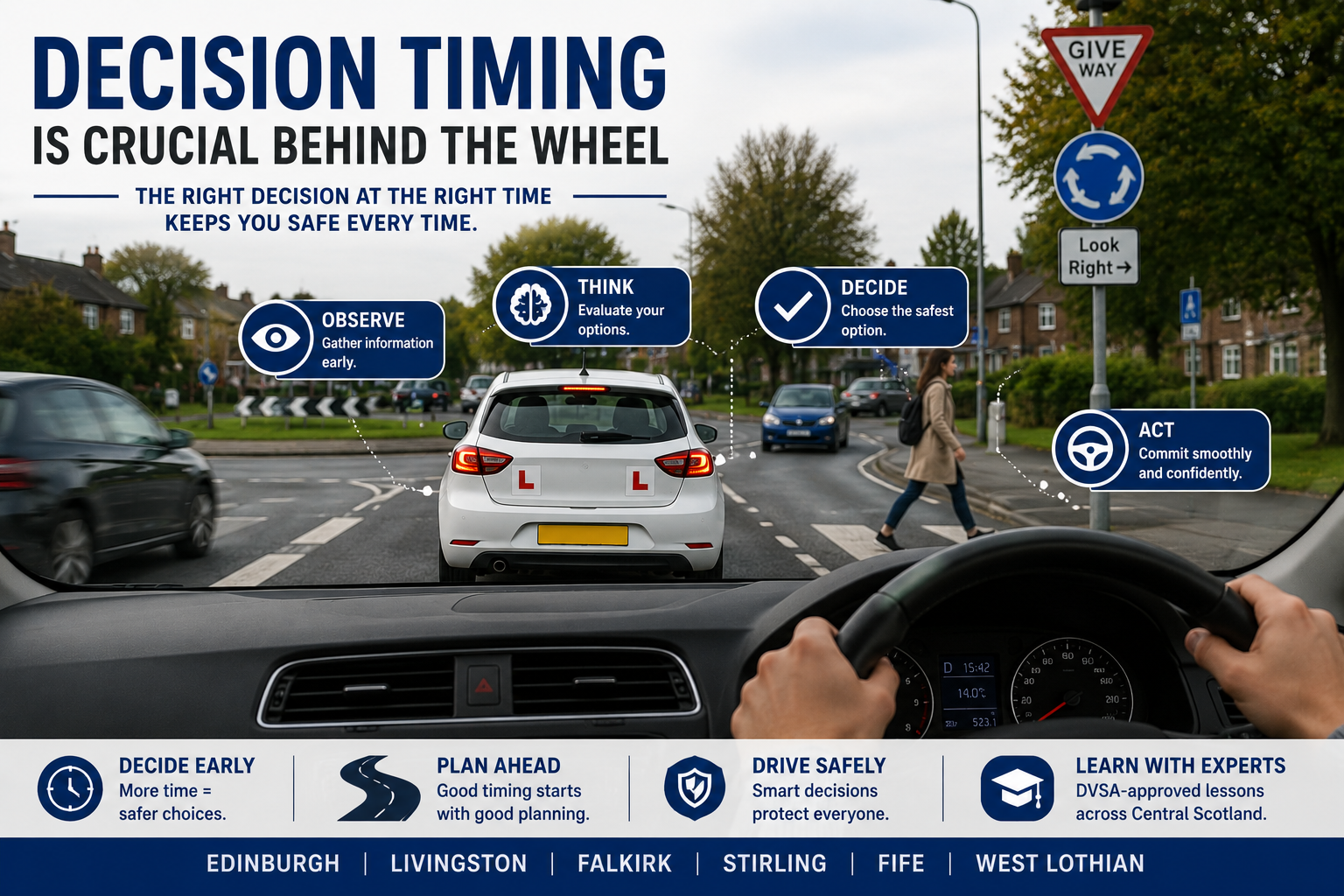
Learning to drive isn’t just about steering accurately or changing gears smoothly. One of the most important skills every learner driver develops is knowing when to make the right decision. Good decision timing allows you to respond safely to changing road conditions, avoid unnecessary risks, and drive with confidence.
Whether you’re approaching a roundabout, joining a dual carriageway, or responding to traffic at a busy junction, making the right decision at the right time is essential. Acting too early or too late can increase stress and affect your ability to drive safely.
At STUART’S Driving School, our DVSA-approved instructors help learners develop effective decision-making skills through structured driving lessons across Edinburgh, Livingston, Falkirk, Stirling, Fife, West Lothian, and throughout Central Scotland. Our goal is to prepare learners for safe, independent driving—not just success on the practical driving test.
What Is Decision Timing?
Decision timing is the ability to recognise the right moment to take action while driving. Every journey requires continuous decisions, from adjusting your speed to choosing the safest road position or deciding when to enter a junction.
Good decision timing relies on:
- Effective observation
- Forward planning
- Reading traffic conditions
- Recognising developing hazards
- Maintaining safe space around your vehicle
- Staying calm under pressure
When these skills work together, driving becomes smoother, safer, and more predictable.
Why Good Timing Makes Driving Safer
Experienced drivers rarely make rushed decisions. Instead, they observe the road ahead, assess potential risks, and take action at the appropriate moment.
For example, slowing down early when approaching a busy junction gives you more time to observe traffic and choose a safe gap. Waiting until the last moment often leads to harsh braking, hesitation, or poor judgement.
Good timing helps reduce pressure and allows you to respond confidently in changing traffic conditions.
Situations Where Decision Timing Is Essential
Every driving lesson presents opportunities to practise good decision timing.
Approaching Junctions
Choosing the right moment to move away safely depends on good observation, patience, and awareness of other road users.
Roundabouts
Entering a roundabout too early or hesitating unnecessarily can interrupt traffic flow. Learners are taught to assess approaching vehicles carefully before committing.
Changing Lanes
Good timing allows drivers to check mirrors, assess blind spots, signal clearly, and change lanes without affecting surrounding traffic.
Meeting Oncoming Traffic
Narrow roads often require drivers to judge when it is safe to continue or when to give way. Careful planning helps avoid unnecessary risks.
Responding to Traffic Lights
Observing traffic well ahead helps drivers adjust their speed naturally instead of braking suddenly when lights change.
How Observation Supports Better Decisions
Decision timing begins with good observation. The more information you collect about your surroundings, the more time you have to make safe choices.
Effective observation includes:
- Checking mirrors regularly
- Looking well ahead
- Monitoring traffic flow
- Watching pedestrians and cyclists
- Reading road signs early
- Recognising changing weather conditions
These habits help you anticipate situations before they require immediate action.
Common Decision Timing Mistakes Learner Drivers Make
Every learner improves with practice, but some common habits can affect decision-making.
- Rushing into junctions
- Waiting too long to make a safe move
- Braking sharply instead of planning ahead
- Changing lanes without enough preparation
- Reacting late to changing traffic conditions
- Focusing only on the vehicle ahead
These challenges are completely normal and improve through structured lessons and regular feedback from a qualified instructor.
How STUART’S Driving School Develops Better Decision Timing
At STUART’S Driving School, we encourage learners to think ahead instead of simply reacting to situations.
Our instructors help learners develop the confidence to:
- Read traffic conditions effectively
- Recognise safe opportunities
- Choose the correct road position
- Adjust speed smoothly
- Respond calmly under pressure
- Make informed driving decisions
This structured coaching approach follows DVSA teaching principles and helps learners become safe, independent drivers.
Decision Timing During the Practical Driving Test
Throughout your practical driving test, the examiner will assess how confidently and safely you make driving decisions.
You may be assessed on your ability to:
- Approach junctions safely
- Select appropriate gaps in traffic
- React to pedestrians and cyclists
- Maintain safe speed
- Respond to changing road conditions
- Plan ahead throughout the drive
Good decision timing demonstrates that you can drive responsibly without constant guidance.
Building Confidence Through Experience
Decision-making becomes more natural with regular practice in different driving environments.
During lessons with STUART’S Driving School, learners gain experience on:
- Busy city streets
- Residential roads
- Rural routes
- Dual carriageways
- Roundabouts
- Higher-speed roads
Experiencing different road layouts and traffic situations helps learners build confidence and improve their judgement over time.
Good Decisions Create Safer Drivers
Passing the practical driving test is only the beginning of your driving journey. The decisions you make every day after passing will have the greatest impact on your safety and the safety of others.
By developing strong observation, planning ahead, and choosing the right moment to act, you will become a calmer, safer, and more confident driver.
At STUART’S Driving School, our experienced DVSA-approved instructors provide structured driving lessons that help learners develop these essential lifelong skills. Whether you’re taking your first lesson or preparing for your practical driving test, we’ll help you become a safe, responsible, and independent driver across Edinburgh, Livingston, Falkirk, Stirling, Fife, West Lothian, and throughout Central Scotland.